Friday, February 23, 2007

Angry Man, Hungry Woman

After a short bout of African tummy (food poisioning/water contamination/any damn thing) this week followed by a hectic training day with the Maama Suubi ladies (I taught them how to make real American chocolate chip cookies that muzungus will pay a pretty penny for), I'm forced to take a breath. With so much mounting in these next two weeks , it is hard to stand still, move outside myself and really take a look at what is happening. I'm about to leave Africa. As quickly as I came, I'll be gone. And there is not enough time in the world to do what I came here to do or to reflect on what that actually is, everything is a whizzing whir of questions, longings, unknowings and excitements.

A few of you (readers) have wondered why I have not posted in a while, but the truth is I've been so busy and overwhelmed it's hard to get a minute to myself, let alone for reflection. Our days are filled with field work and the always daunting tasks of getting there - do I take a crowded matatu (taxi bus), a slightly dangerous picky (motorcycle taxi), boda-boda or what? -, keeping the house clean, paying the bills (Will), figuring out dinner (Me), planning for lessons or training and trying to get a moment of relaxation. In some ways I'm strapped between the two continents: I want to be home but I want to finish my project and put a close to my life here with as much integrity as possible. The stress of life in Uganda, coupled with a volunteer's bank account, is piling up at the same time the responsibilities are piling high. Now I'm comfortable under stress, relative poverty and high productivity levels - but it is still wearing Will and I a bit thin.

Sometimes I think I couldn't do it without him, and he says the same of me, but we both know we would be able to do this without the other, but maybe not as well. After all the daily events that can wear on a psyche, both the tiny and monstrous sadnessess and dramas that play themselves out each day on this stage, I feel such a comfort to come home to Will. We can laugh (or cry) about the days events; make ramen, tuna sandwiches or grilled cheese over candlelight (not on account of romance, I assure you) and thank our lucky stars for our well-being, the possibility of a better tomorrows and mostly for one another.

The title of this post is from a great little James Taylor tune, and one that my parents quote as being "one of their songs." An homage to love in hard times, it's about holding on. Holding on to eachother, for a better day, for getting it right, even if it's next time around. But it also has a sense of humor, a coping skill too valuable to ever lose.

So, I thought it fits our crazy love story in Uganda. Life's a little messed up, sometimes we drive eachother crazy, but mostly we'd go crazy without eachother.

And everything's going to be alright, if we just hold on.

Wednesday, February 07, 2007

The White Shroud

shroud
n. a cloth or sheet in which a corpse is wrapped for burial

There are some days that stick with you for the rest of your life. On those days that begin as any other, something happens to forever alter what you thought was sound, true or fast - a bottle is thrown, glass shatters and there are suddenly not as many pieces as their once were. The shards will never form the same creation again.

With innocence forever lost, the white flag of youth is stained and buried with the dead. And by bearing witness yours is buried with it.


* * *

Yesterday was a dreary, soggy day in the village. While walking to the hut where I teach women, I noticed there weren't many people shouting "Maama Suubi, you're welcome!" or the less endearing "Muzungu, how are you?" So I trudged through the mud toward our hut, a white flip chart in hand and a backpack full of contraceptives and condoms for the family planning session I had planned for the afternoon. With my hiking shoes and bottoms of jeans covered in the earth, I thought about how old the dirt on my feet must be for the first time that day. Life began not far from here, I thought, and how many generations of humans must be buried in this very soil?
Finally, seeing a familiar face of one of my older members, I feel a sense of relief by her welcoming smile. "Mama Suubi, we are going for burial today," she says with a calm and somber, not sad, voice. "You come with us, won't you?"

I don't think I have much of a choice in the matter so I follow the processional of ladies, many of them the ones I see every week when we talk about how to feed children, prevent pregnancy or best market their goods. As we walk through the dirt foot paths through the village, the procession grows as we pick up new women and children along the way. When we reach the home where the burial will take place, which is nothing more than a two-roomed mud hut with a grass and mud surrounds, my mind flashes to any funeral I've ever been to. Church bells. Women dressed in dark dresses and black panyhose. The pristine smell of a Catholic cathedral hallway. The eucharist, the wine. The priest's ornate cloth, the holy water, the organ's dirge. My great-grandmother's hand, so cold, so beautiful in its old age. Then to an icy Michigan day, an intricate coffin lowered into the earth. A few shovels of dirt, a wail, and it's over.

But here the burial is but fifty villagers dressed in traditional clothes mixed with Salvation Army donatees, "Anaheim Mighty Ducks," "Don't Mess With Texas" shirts cover children with skin made dirty by a life without shoes. Some are wearing no pants on this chilly day by Ugandan standards. There is a dusty Bible held by a minister, which they read in their own language, but no ornate cloth or smell of cleanliness, Godliness and other church scents. No bells, only the soul-stirring African harmonies of songs more ancient than their Christianity. At the front of the processional, two men carry a body from the home wrapped in a white cloth. The singing swells, and so do eyes. A woman who is apparently the mother kneels in the mud wailing, tears and mucus staining her face. The body is carried in a white sheet tied in a single knot above his head.

I did not expect it to be a child, I think, standing but shattered, as the tiny frail body is lowered on to a straw mat. It's limp head is leaning to one side in the shroud. His shoeless feet are no bigger than my hands. He's wearing blue and white striped short suit.

"He was only three years," my friend Zainab whispers. "He is my sister's son. This is the third child she has lost," another woman, Scovia, says between lines in a song. The high-pitched wailing of the bereaved mother fills my ears and claws at my heart. My child will never die of malaria at three years old, I think, with bitterness at this unjust realization. I try to keep my composure, because I don't want to draw attention to myself - I am already a noticable visitor - and I bite back tears for only another 30 seconds until they push me to the front where a man unties the white sheet and shows me his face. Dark and beautiful, so young, and so lifeless. With that I no longer can hold any composure and I cry with them. I cry for this child, for the inability of life here to prevail over common diseases and maladies, for all the children who die in Africa and everywhere, for my privledged and contemptuous faith in goodness, an innocence forever lost by the sight of this dead child; for his mother who must endure so much pain which depsite its frequency never becomes any easier. And I think of how human suffering is all the same; ugly, desperately gruesome and everywhere.

The body is lifted and lowered just four feet into the earth of his back yard. Men we'd call paulbearers lay wooden planks over the boy and then heavy, wet earth. The same earth, I think, remembering my vague nostaligia earlier, that has already buried so much of humanity. His mother crawls away, not able to walk with the unbearable grief of losing another child, and the crowd dissipates; women chatting, some sobbing, men congregating in chairs. Soon life will return to normal, except something remains changed. For me I will never look at a white sheet and think of peace, justice or hope but what exists in their absence; death, suffering and in some ways, the human story.

Another baby was lowered into the earth that day, with only a white shroud separating his tiny body from the earth that consumed him.

Sunday, February 04, 2007

The Big Picture


A few favortite shots of faces and places.
Location: the pearl of Africa. Time: October through Janurary. Mode: in collage.


From left:

1.View of the fierce and gorgeous Ssese Island paradise, taken during our first visit in October.

2. Little Debo, the most beautiful baby girl in Africa in my most biased opinion.

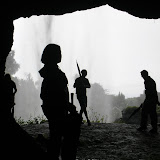
3. Shadows in Neverland. Simply a breathtaking photo with real-life mysticism, taken by Grant at Sipi Falls. We're standing in a cave underneath the waterfall.

4. Demonstrating how to correctly use a condom during an HIV seminar in Buwesswa village. They had the phallus for this purpose exactly, except most of the people had never seen a condom. Some things are just too strange to question...

5. Maama Suubi cake, symbolic of the many income-generating cakes they will make in the near future.

6. Dusk over the Karamoja plains: view from above the Sipi Falls.

7. Cooking mexican rice in Mbale in our homey little kitchen.

8. My feet, Africanized. Take a look at the tan lines, scabs, scars and various mosquito, ant and gnat bites. Cute, eh? Somebody needs a pedi...

9. Open air in Buwesswa village where Will and I hold HIV/AIDS and savings and credit seminars for farmers' cooperative members and their community.

10. Painting the youth center library at TASO, the first project of my internship.

11. Baby at Buwesswa village, with eyes that say it all. She was a beautiful, fat toddler with a face that could make anyone weep.

12. Will and I at our favorite little Indian place, enjoying eachother and slightly skunky Guinness.

13. Just a close-up of yours truly.

14. Little mommies at World AIDS Day in Nauyo, there are a thousand stories in their expressions, with the hope of our world sparkling in those dusty eyes.

15. Sunset over Lake Victoria.

16. Will in the world. Here he's with Jenepher after constructing an energy-saving stove, which uses less firewood and drastically cuts down on time women spend collecting firewood.